Overlay, neighborhood, proximity order
A Swarm node has an overlay address — a 32-byte identifier in the same address space as chunk references. This overlay determines where in the network the node sits, and therefore which chunks it’s responsible for storing and serving.
bee-check calls GET /addresses on every vantage and surfaces:
overlay— the node’s full 32-byte overlay (rendered as 64 hex chars).neighborhood— the first byte of the overlay, by convention the unit used when discussing where a chunk “lives”.proximity_to_root— how close the node sits to the reference being probed (defined below).
Proximity order (PO)
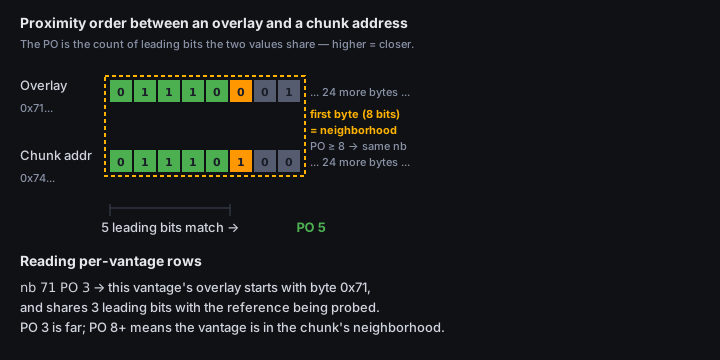
Given two 32-byte values A and B, the proximity order is the number of leading bits they share. Higher = closer.
| PO | Leading bits matching |
|---|---|
| 0 | none — they differ at the very first bit |
| 4 | first 4 bits (i.e. first hex nibble) match |
| 8 | first byte matches — same neighborhood |
| 16 | first two bytes match |
| 32 | first 4 bytes match — very close |
| 256 | identical |
In Swarm, chunks with address X are pushed toward (and stored by)
peers with high proximity to X. So a vantage with PO 8+ to the
reference is in the chunk’s neighborhood; a vantage with PO 0 or
PO 1 is on the other side of the network and is sampling
retrieval through the network, not local storage.
Reading the per-vantage row
nb 71 PO 3
means: this node’s overlay starts with byte 0x71 (neighborhood
71), and its overlay shares 3 leading bits with the reference
being probed. PO 3 is far — the node is not in the chunk’s
neighborhood, so a “yes” here genuinely means the network retrieved
the content for this node from elsewhere.
Per-chunk proximity
With --per-chunk, each chunk also reports per-vantage proximity to
that specific chunk’s address. So a --per-chunk report can say:
chunk
1a2b…(neighborhood1a) was missing onhttp://b.example(overlayc4…, PO 0 to this chunk) but found onhttp://a.example(overlay1a…, PO 8 to this chunk)
That’s diagnostic gold: the chunk is only answerable by a node in its own neighborhood; the rest of the network either doesn’t know about it or can’t route to a storer.
See also
- Swarm docs — Address space and Kademlia (the Book of Swarm chapter on overlay topology)
- Bee API —
GET /addresses
--target-overlay: framing the question
bee-check --target-overlay HEX re-sorts the vantages closest-first
to a hypothetical target overlay and tags each with
target_proximity. Use this when you’re asking “from a node near
neighborhood X, is this retrievable?” — useful when you’re debugging
a specific user’s experience and you know their overlay.